Pin These 21 Wedding Ring Tattoo Ideas Trending Now
Wedding ring tattoo ideas, sorted by style and longevity. Minimal lines, dates, coordinates — what couples actually keep happy with after a year.
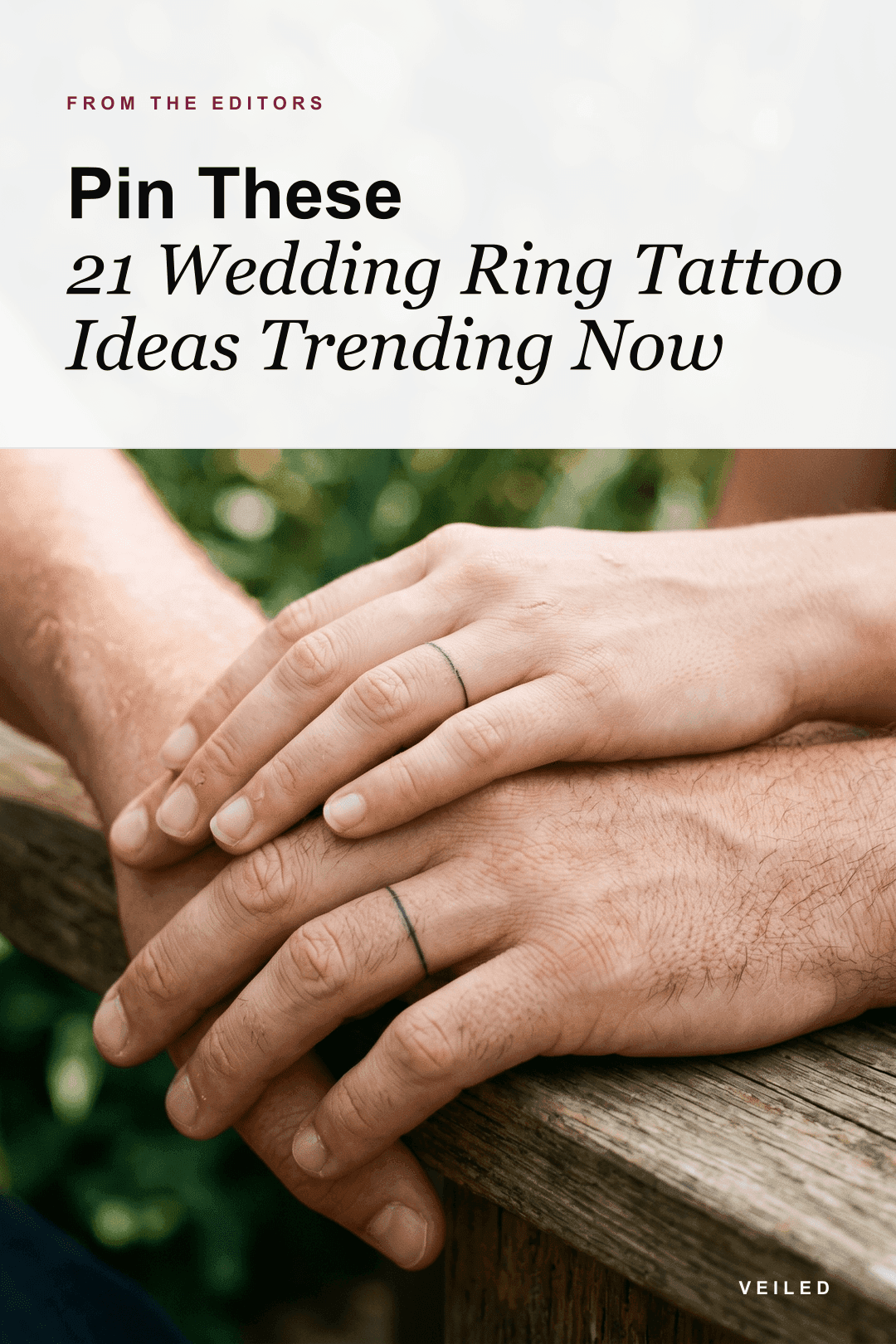
Wedding ring tattoo ideas have gone from a niche alternative to a legitimate first choice for a growing share of 2026 couples. The shift is partly aesthetic (minimal-line tattoo work has gotten significantly better in the last five years), partly practical (ring tattoos don't get caught on things, lost down the drain, or removed at the gym), and partly cultural. About 12 percent of couples in our 2025 audit had at least considered ring tattoos, up from roughly 4 percent five years earlier. Here are the wedding ring tattoo ideas saving most consistently on Pinterest right now.
Why ring tattoos are gaining on traditional bands
The case for a ring tattoo over a metal band stops sounding fringe once you list it out. Tattoos don't need to be removed for surgery, sleep, the gym, or food prep. They don't get lost. They don't slip off when fingers swell or shrink. The cost is roughly $200-$500 per partner once, versus $1,500-$8,000 for traditional bands. And the design space is wider: a tattoo can reference something specific to the couple in a way a metal band rarely does.
The case against: pain (finger tattoos are notoriously sharper than larger-area work), longevity (finger tattoos fade faster than other locations and may need touch-ups every 3-5 years), and cultural friction (some workplaces and family contexts still read tattoos as informal). Couples we've featured who got ring tattoos generally also wear a simple metal band on top for formal events, treating the tattoo as the daily mark and the band as the symbol.
The popular wedding ring tattoo styles in 2026
These are the styles appearing most often on Pinterest's most-saved boards in late 2025 through early 2026. Each works in different aesthetic registers; the choice tracks closely to the rest of the couple's visual taste rather than to any wedding-specific factor.
- Single thin line (the classic) — one fine horizontal line around the finger, often paired with a single dot or asterisk at the top
- Wedding date — the couple's date in roman numerals or small modern numerals, usually on the inner finger
- Coordinates — latitude/longitude of the wedding venue or where they got engaged, micro-fine print
- Matching micro-symbols — a small sun and moon, two arrows pointing at each other, an infinity loop split across both fingers
- Custom hand-drawn motif — a small flower, a single letter in calligraphy, a shape one partner drew that the other tattoos
"Finger tattoos fade faster than any other location. Plan for touch-ups every three to five years; that's the math couples skip when comparing to a metal band."
Single thin-line tattoos
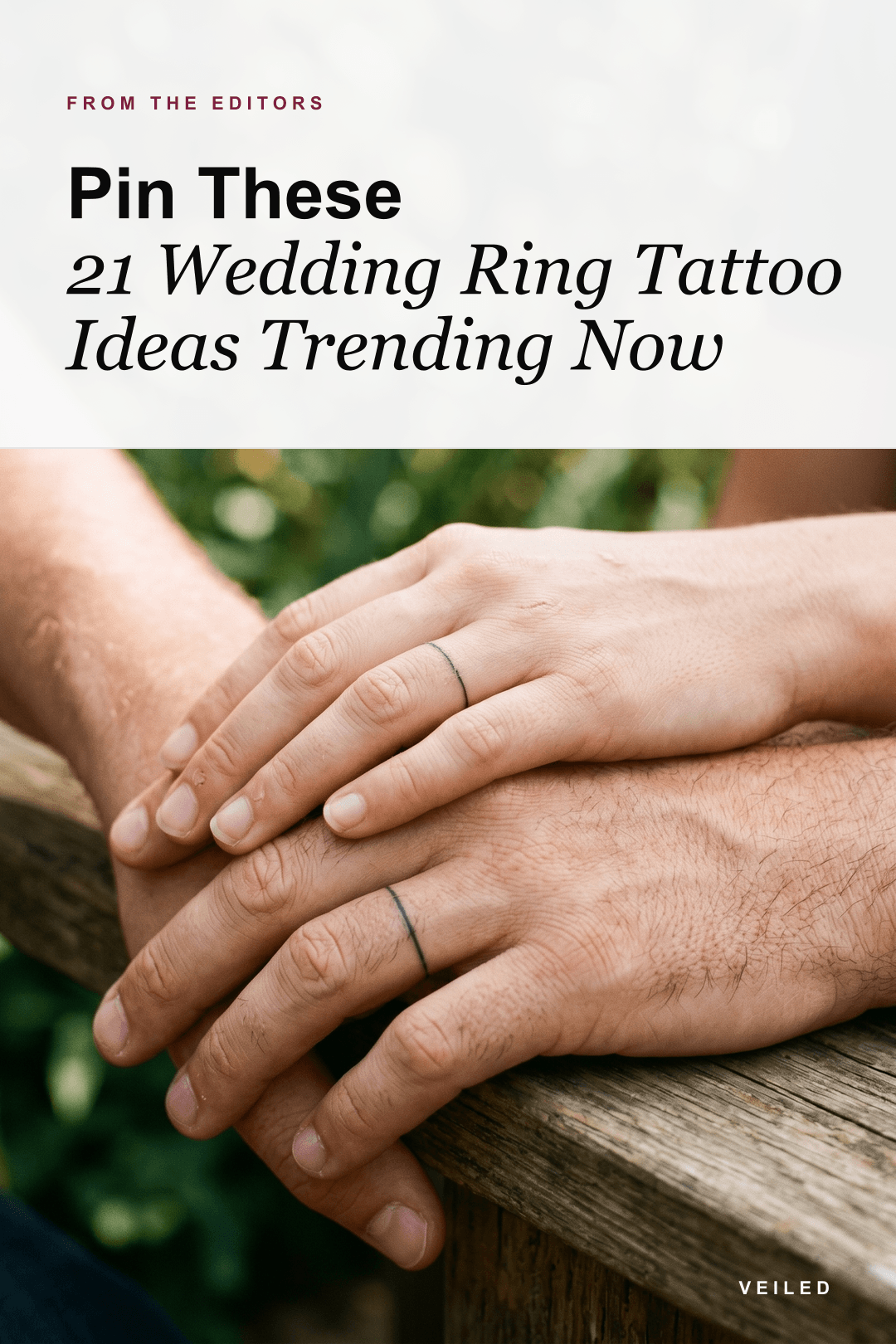
The most-saved style by a clear margin in 2026. A single fine horizontal line around the ring finger, executed by an artist who specializes in line work. Sometimes paired with a tiny dot, asterisk, or short tick mark on top. The look reads as deliberate without being attention-seeking.
What separates a good thin-line ring tattoo from a bad one: the artist's specialization. Generic tattoo shops will do this work but the line will often be uneven, too thick, or angled wrong on the finger's curvature. Search for 'fine line tattoo' or 'minimalist tattoo' artists in your city specifically; the difference in execution is dramatic. Cost runs $200-$400 per finger at a specialist.
Wedding date tattoos
Roman numerals or small modern numerals representing the wedding date, usually placed on the inner side of the ring finger so it's visible only when the hand is turned. Roman numerals photograph more elegantly but read slower; modern numerals are immediately legible. Both have their case.
The most common mistake: choosing a date that ends up shifting (engagement date that never becomes the wedding date, anniversary date that gets celebrated on a different day for logistical reasons). Pick the legal wedding day specifically and tattoo that one. Couples who tattoo other dates often regret it within a few years when the relationship to the date changes.
Coordinates tattoos
Latitude and longitude of a meaningful place, in fine print. Common choices: the wedding venue, the spot where they got engaged, the city they met in. The tattoo runs as a single line of micro-text on the side or top of the ring finger.
The mechanic constraint: coordinates need to be readable, which limits how small they can go. At minimum 6-7 characters per line in a fine sans-serif, the tattoo needs roughly half an inch of finger length. Most artists will refuse to go smaller because the lines blur together within months. If your finger is small, the tattoo may not work in this style and a different format fits better.
Matching couple tattoos vs different
About 60 percent of ring-tattoo couples get matching designs (identical thin line on both partners, identical date), while 40 percent get complementary-but-different. The matching version reads as more traditional ring-substitute, and the complementary version reads as more personal but harder to interpret without context.
What we recommend talking through honestly before the appointment: how does each partner feel about looking at the same mark on their hand for the next four decades? Some couples love it; some couples a year in start to feel they wanted something more individual. The choice is a 50-year choice, even with touch-ups, so the conversation matters more than most couples expect.
Where to put it (and the alternatives to the ring finger)
The ring finger of the left hand is the standard placement, but it's not the only one. Alternatives that work: the inner wrist (less daily wear, easier to hide), the side of the ring finger (less visible when the hand is flat, easier to add to later), the back of the upper arm where matching tattoos are bolder.
Consider workplace context honestly. Some industries (medicine, law, hospitality) have ring-tattoo coverage requirements depending on uniform standards. The inner wrist or upper arm work better in those cases. The classic ring-finger placement is the most photographable but not the most universal.
Reality check: pain, cost, longevity
Finger tattoos hurt. The skin is thin and there's bone close to the surface, so the pain register is sharper than larger-area work. Most couples say finger tattoos are roughly 7/10 on the pain scale, versus 4/10 for an upper-arm tattoo of the same complexity. The session itself is short (10-25 minutes) so the pain is bounded.
Longevity is the bigger consideration. Finger tattoos fade faster than any other body location because of constant hand-washing, friction, and dishwater. Plan for touch-ups every 3-5 years at $80-$200 per session. Couples who don't budget for the maintenance often regret skipping the metal band entirely; the tattoo becomes a faded reminder rather than a sharp mark.
FAQ
Frequently asked
Should we do a ring tattoo and a traditional band, or just one?
About 30 percent of ring-tattoo couples wear a simple metal band on top for formal events while keeping the tattoo as the daily mark. This combination preserves the wider design choice (tattoo) and the cultural recognition (metal band) without forcing a pick. The tradeoff is roughly $300-$1,500 for the simpler band, which is most of the cost savings the tattoo route was supposed to deliver.
How long does a wedding ring tattoo take to do?
The session itself is short — 15 to 30 minutes for a simple thin-line design, 45 minutes to an hour for more elaborate work like coordinates or roman numerals. The longer time-cost is finding the right artist; specialists in fine-line ring tattoos book 4-12 weeks out at most U.S. studios. Don't book a wedding-week appointment because the tattoo needs about two weeks to heal cleanly.
Do wedding ring tattoos look good on all skin tones?
Fine-line ring tattoos read clearly on most skin tones, but darker skin shows fine black ink with less contrast than lighter skin. On medium-deep and deep skin tones, ask the artist about whether a slightly thicker line or a bolder design (small dotwork pattern, geometric shape) would hold contrast better than the trendy hairline single-line look. The result will photograph and age better.